

When people begin exploring forms of healing outsideo of Western medicine (also known as Allopathy), they often turn toward holistic healing. Two of the most well-known systems encountered are Āyurveda and Traditional Chinese Medicine (TCM). Both are ancient, sophisticated, and deeply rooted in the idea that the body functions best when it is in balance. However, while they may appear similar on the surface, they are built on very different foundations.
What is TCM?
TCM is a holistic system of healing from East Asia that was first officially documented over 2,000 years ago. It focuses on restoring balance within the body by regulating the flow of vital energy, known as Qì (pronounced chee), and harmonizing opposing forces like Yīn and Yáng. Rather than isolating a single cause, TCM looks at patterns of imbalance across the entire system. Think:
- Acupuncture
- Meridian and energy channel work
- Herbal formulas
- Cupping and moxibustion
- Food therapy
TCM views the body as an interconnected network, where symptoms are signals of deeper imbalance rather than isolated problems. Treatment focuses on restoring proper flow, clearing stagnation, and strengthening areas of deficiency. While it can support acute conditions, TCM is especially effective for chronic patterns, prevention, and maintaining long-term balance within the body.
Different Maps of the Body
Both systems are holistic, but they are not interchangeable. Each one uses its own language, logic, tools, and diagnostic approach. Āyurveda comes from India in South Asia, and while similarly focused on balanced health, it is rooted in Vedic philosophy and understands health through concepts like:
- Doshas (Vata, Pitta, Kapha)
- Agni (digestive / metabolic fire)
- Dhatus (tissues)
- Srotas (channels)
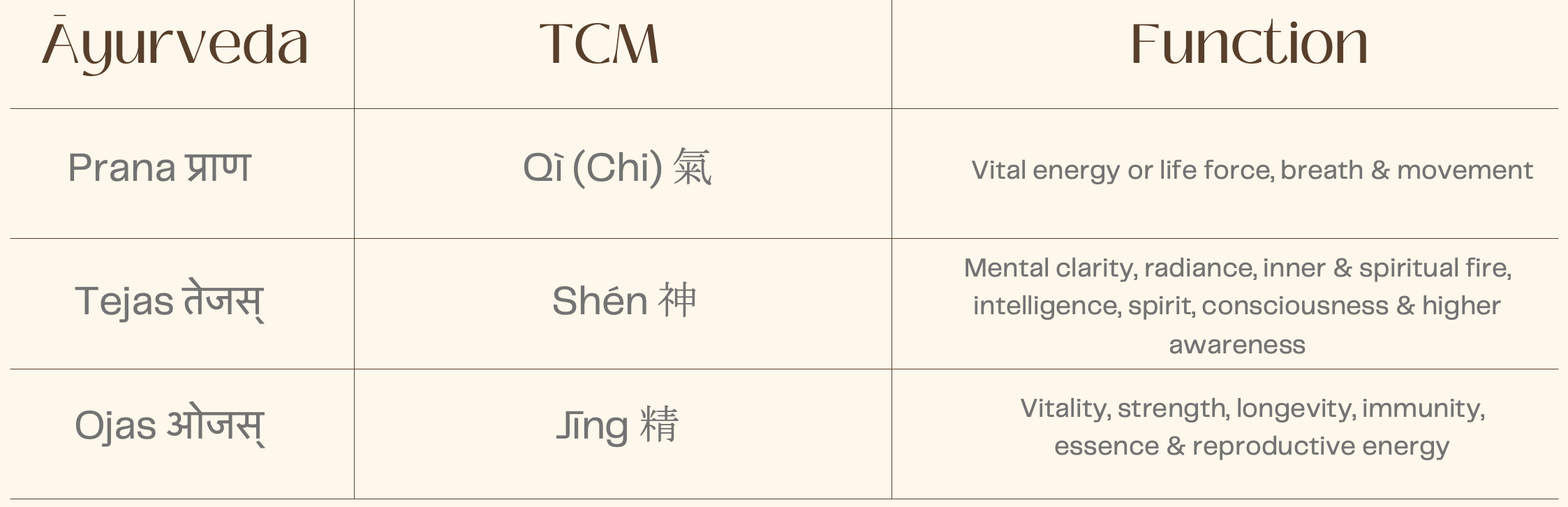
- Ojas (vital essence)
TCM comes from the other side of the Himalayas in China and is based on a different energetic model, including:
- Qì 氣 (Shén 神 and Jīng 精)
- Yīn 陰 and Yáng 陽
- The Five Elements
- Meridians
- Organ systems and energetic flow
How They Approach Imbalance
One of the biggest differences between Āyurveda and TCM is how they identify the root of imbalance. Āyurveda often looks first at digestion, constitution, lifestyle, and whether the doshas are aggravated or depleted. It places a strong emphasis on how food, routine, season, and mental state affect the body over time. TCM tends to focus more on the movement and quality of Qì, blood, fluids, heat, cold, dampness, and stagnation throughout the system. It often interprets symptoms through energetic excess, deficiency, or blockage. Both systems are trying to understand why symptoms are happening, but they organize that understanding differently.
Where They Overlap
Āyurveda and TCM share several important principles: Prevention matters, the body is interconnected, symptoms are not the whole story, lifestyle plays a major role in health, and healing requires balance, not just symptom suppression. In fact, when looked at objectively, there are several aspects that align.
This is why many people feel drawn to both systems, especially after becoming frustrated with purely symptom-based care that is often attributed with Allopathy. Āyurveda and TCM are both powerful systems of healing that can work wonders for chronic conditions, however they are not the same. Each offers a distinct map of the body, mind, and energetic system. The goal is not to compare them side-by-side, but to understand the unique wisdom each one offers. The more clearly we understand these systems, the more intentionally we can choose the tools, language, and practices that support healing for individual constitutions.